Leadership Self-Awareness: The Discovery Stage
CHAPTER FOUR
Liam Patel had not planned to cry in front of a stranger. But here he was, forty minutes into his first session with an executive coach, eyes wet, voice cracking, talking about his mother.
It had started, as these things often do, with something professional. Liam was the incoming Vice President of Product Strategy at NovaPharm, a global pharmaceutical company headquartered in Toronto. Forty-one years old, technically brilliant, recruited for his ability to manage complexity and drive timelines. His new role put him in charge of the launch pipeline for a diabetes treatment that had been in development for seven years.
The product was behind schedule. The Gantt chart on the boardroom wall was a sea of red and amber bars. Cross-functional teams were misaligned. Regulatory had one timeline, marketing had another, quality control felt permanently out of the loop. In his first leadership meeting, Liam had asked the room, plainly, why they kept falling behind. A colleague named Priya, one of the few who seemed willing to be direct, said: “Because nobody knows what you’re thinking. You hold everything close. People can’t align with someone they can’t read.”
Liam had brushed the comment off in the moment. But it stayed with him. It followed him home that evening and sat with him at his kitchen table while he ate dinner alone. It was still there the next morning.
He called the company’s leadership development team and asked if they could recommend a coach. Not because he believed in coaching, necessarily. But because Priya’s words had opened a door he didn’t know how to close.
* * *
Knowledge before action
Chapter 1 introduced the four stages of the Versatile Leadership framework: Discovery, Goals, Support, and Creation. We begin Part II with Discovery because it is where everything else originates.
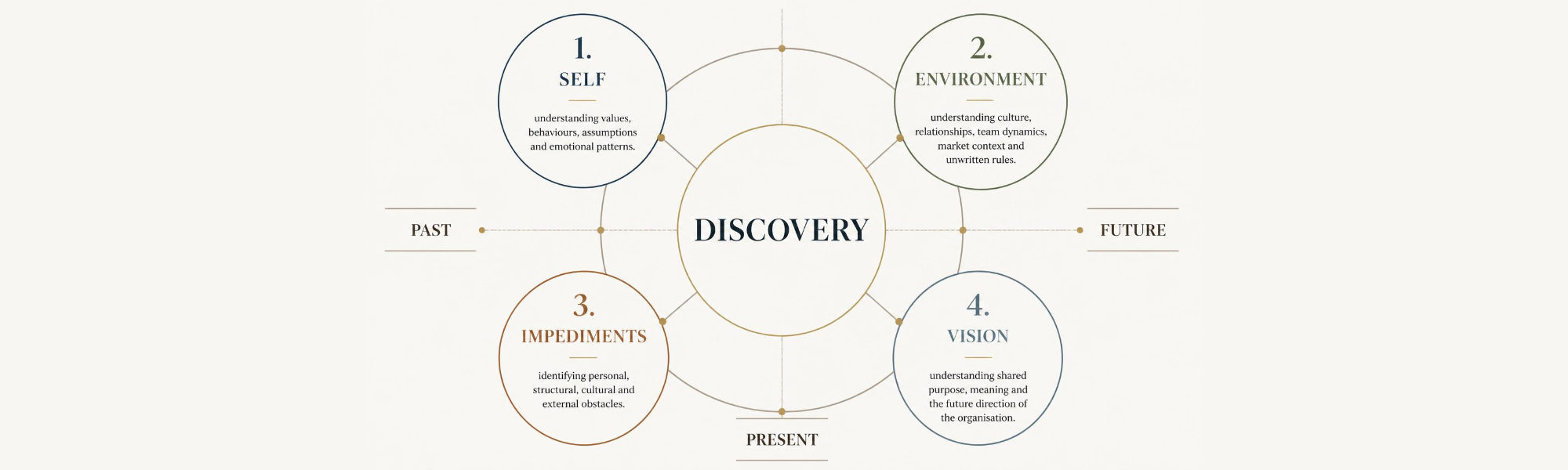
The framework starts from a simple premise: you cannot lead well what you do not understand. And the understanding that matters most is not the kind you find in reports or dashboards. It is the deeper kind, the kind that requires patience and honesty: understanding yourself, understanding the world you operate in, understanding what stands in your way, and understanding where you are actually trying to go.
Discovery has four dimensions, and each one operates across three lenses of time: what came before, what exists now, and what is forming on the horizon. This layering matters. A leader who only reads the present is permanently reactive. A leader who fixates on the future loses contact with the ground they’re standing on. Effective discovery moves between all three.
Liam, in his first weeks at NovaPharm, had plenty of present-tense data: project statuses, headcount reports, budget forecasts. What he lacked was everything underneath that data. He didn’t understand the organization’s history, its emotional patterns, or its unspoken rules. He didn’t understand his own patterns, either. He was about to learn.
* * *
Self-discovery: the hardest kind of knowledge
Liam’s coach, a woman named Adele who had spent twenty years working with executives in high-pressure industries, started their first session with a question he didn’t expect.
“Tell me about a time you failed and nobody knew.”
He sat with that for a long time. Eventually, he told her about a product recall at his previous company. He’d caught the quality issue three weeks before it became public. He’d flagged it. He’d been overruled. When the recall happened, he said nothing. He didn’t defend himself, and he didn’t push back against the leadership team that had dismissed his concern. He absorbed the blame quietly.
“Why?” Adele asked.
“Because that’s what I do. I take it. I move on. I don’t make noise.”
“And where did you learn that?”
That was the question that led to his mother. Liam was the son of two Indian immigrants who had built their life in Canada through relentless work and quiet perseverance. His father drove a taxi for fifteen years before saving enough to open a small pharmacy. His mother, a trained chemist, worked as a lab technician for a salary well below her qualifications, never once complaining. She had also lived with Type 2 diabetes for as long as Liam could remember, managing it silently, never letting it define her.
Liam had absorbed their ethic completely. Work hard. Don’t draw attention to yourself. Let results speak. Don’t burden others with your struggles. These were not bad values. They had built a family and a career. But they had also built a wall. Behind that wall, Liam had a rich inner life, strong convictions, and real vulnerability that nobody in his professional world had ever seen.
Self-discovery, in the framework’s terms, means examining your values, your cultural conditioning, your emotional habits, and the deeper patterns of how you show up. The purpose is not navel-gazing. It is practical: until you understand how you are perceived by the people around you, you cannot understand why they respond to you the way they do. For Liam, the catalyst was Priya’s comment in that boardroom. His stoicism, his restraint, his habit of holding everything close, these looked like composure from the inside. From the outside, they looked like distance.
Over the following weeks, Adele guided him through a structured process. He wrote about his values: what he actually believed, not what he thought a VP was supposed to believe. He took a 360-degree feedback assessment that included peers, direct reports, and two people who had worked with him at his previous company. Some of it confirmed what he already knew. Some of it hurt. One peer wrote: “He is the most competent person I have worked with, and the loneliest.”
Self-discovery is not therapy, though it can feel like it. It is the disciplined practice of examining the patterns, assumptions, and emotional habits that shape how you lead, especially the ones you’ve never questioned because they’ve always been there.
* * *
Environmental discovery: reading the system
While Liam was doing inner work with his coach, he also started paying attention to his organization in a different way.
The Versatile Leadership framework calls this environmental discovery: understanding the unique ecosystem in which a leader operates. This includes the organizational culture, the team dynamics, the market context, and the unwritten norms that shape how people actually behave (as opposed to how the company handbook says they should).
Liam had spent his first weeks at NovaPharm absorbing data: financial reports, org charts, project documentation. But he hadn’t absorbed the organization itself. He hadn’t noticed, for instance, that the regulatory team always sat on the opposite side of the cafeteria from the commercial team, and that the two groups almost never ate together. He hadn’t noticed that junior researchers stopped talking when senior leaders entered the room. He hadn’t noticed that meeting agendas were distributed but never followed, because the real decisions happened in hallway conversations afterward.
He started spending time in places he normally wouldn’t. A full morning with the quality control team, not reviewing metrics, just observing how they worked and what they talked about. An afternoon in the field operations office, where a logistics coordinator named Mei told him, with a politeness that barely masked her frustration, that she had submitted the same process improvement suggestion three times over two years and never received a response.
“Where did the suggestions go?” Liam asked.
“Into the system,” she said. “Same place everything goes.”
Environmental discovery isn’t a one-time exercise. It is an ongoing practice of observing, asking, and making sense of the patterns around you. A versatile leader reads their environment the way a sailor reads the water: not just the surface, but the currents underneath, the weather on the horizon, the shifting conditions that no chart can fully capture.
* * *
Impediment discovery: naming what blocks the way
By his second month, Liam had begun to assemble a picture. But pictures are useless if you can’t see what’s obstructing the view.
The framework’s third dimension of discovery is impediment discovery: the deliberate identification of barriers, pitfalls, and obstacles that stand in the way of a leader’s strategies, and those of their followers and successors.
Liam’s impediments operated at three levels. At the personal level, his assumption that clarity came from silence was wrong. People didn’t experience his quiet as thoughtfulness. They experienced it as withholding. His habit of making decisions internally before announcing them meant that his team felt informed rather than involved, a difference that seems small until you’re the one on the receiving end.
At the organizational level, NovaPharm had a pattern he started calling “the two-week gap.” Every major decision took about two weeks to reach the teams that needed to implement it. By the time quality control learned about a timeline change, marketing had already begun work based on the old one. The gap wasn’t caused by bad technology or slow email. It was caused by a culture where information was treated as a resource to be rationed rather than shared.
At the market level, the pharmaceutical industry was moving faster than NovaPharm’s internal processes could accommodate. Regulatory requirements were shifting. Patient advocacy groups were demanding more transparency. Competitors were compressing development timelines with new approaches to trial design. The old hierarchy, built for a slower world, couldn’t keep pace.
Impediment discovery requires honesty that goes beyond self-awareness. It means being willing to look at the systems you’re part of, not just the ones you oversee, and to admit that some of the obstacles are structural, some are cultural, and some are you.
* * *
Vision discovery: the future as a coordinating force
Discovery’s fourth dimension is vision, and it was the one that took Liam the longest to reach.
The framework describes vision as the essential coordinating factor, the glue that binds an organization together and adds the dimension of future. The versatile leader draws on a depth of vision to underpin their actions.
For most of his career, Liam had worked with goals, not vision. Goals were specific: launch by Q3, hit revenue targets, reduce manufacturing defects. Vision was something he associated with motivational posters and CEO keynotes. He had never needed one.
But as he got deeper into the Discovery process, he realized that NovaPharm’s teams weren’t misaligned on tasks. They were misaligned on meaning. Every department knew what it was supposed to deliver. Nobody could articulate why it mattered beyond the obvious commercial answer.
At a cross-functional offsite in his third month, Liam tried something new. He asked each participant to write down, anonymously, what they wanted NovaPharm to be known for in five years. Not in terms of revenue or market share. In terms of what they’d be proud to tell their children.
The responses surprised him. They were specific and personal. A regulatory affairs manager wrote about patients in rural India who couldn’t access affordable insulin. A data scientist wrote about her father’s diabetes diagnosis and the research paper that had given their family hope. A supply chain analyst wrote simply: “That we cared about the people at the end of the chain, not just the beginning.”
Liam read them all out loud in the session. Then he did something he would not have done three months earlier. He told his own story. His mother’s decades of managing diabetes. The pharmacy his father ran. The quiet, daily work of a family navigating a healthcare system that often felt indifferent to them. The reason he had entered the pharmaceutical industry in the first place, a reason he had never shared at work because it felt too private, too soft, too far from the language of strategy and execution.
The room was silent when he finished. Then someone said, “That’s the company I want to work for.”
Vision discovery is not about writing a mission statement. It is about uncovering the shared purpose that already exists inside the people who do the work, and giving it language, shape, and permission to matter.
* * *
What discovery made possible
Six months after his first coaching session, the diabetes treatment launch was back on track. But the recovery had little to do with better project management. It had to do with a shift in how people related to the work and to each other.
The two-week information gap closed, not because Liam mandated faster communication, but because teams began talking to each other directly instead of routing everything through the hierarchy. Quality control and marketing started holding joint weekly check-ins, something nobody had thought to try before because it wasn’t in anyone’s job description.
Liam himself was different, though not in the way people might expect from a leadership transformation story. He still loved spreadsheets. He still pushed hard on timelines. He still had high standards. But he had added something to his repertoire that hadn’t been there before: the willingness to be seen. To share his reasoning, not just his conclusions. To ask for input before making decisions, not after. To say “I don’t know” when he didn’t, instead of going quiet and figuring it out alone.
Mei, the logistics coordinator whose suggestions had vanished into the system, became the lead of a new process improvement task force. Priya, who had delivered that uncomfortable truth in the first boardroom meeting, became one of Liam’s closest collaborators. She told him later, “I didn’t think you’d actually listen. Most people in your position don’t.”
“Most people in my position,” Liam replied, “haven’t been told the truth as clearly as you told it to me.”
* * *

Beginning the inward turn
Discovery is the first stage of the Versatile Leadership framework, and it is the one that most leaders skip. Not because they don’t value self-awareness in principle, but because the daily pressure of execution makes it feel like a luxury. There is always a timeline to rescue, a conflict to resolve, a report to finish. Discovery, by contrast, asks you to pause. To look at yourself, your environment, your obstacles, and your purpose with a patience that the modern workplace rarely rewards.
But without discovery, the other stages of the framework, Goals, Support, and Creation, rest on shaky ground. You cannot set meaningful goals if you don’t understand what you truly value. You cannot build the right support structures if you don’t see the system clearly. You cannot create anything lasting if you haven’t reckoned with what stands in the way.
Liam’s story is not about a leader who became perfect. It is about a leader who became honest. Honest about his patterns, honest about his limitations, honest about the gap between how he experienced himself and how others experienced him. That honesty was uncomfortable. It remains uncomfortable. Discovery is not a phase you complete and move past. It is a practice you return to, again and again, each time seeing something you missed before.
Bouns Tips
Each dimension of discovery asks you to look backward, inward, and forward. As you read on, you might try turning that lens on yourself:
- What patterns from your past are still shaping how you lead today? Which of them serve you, and which have become constraints you’ve never examined?
- What is happening in your environment right now that you’ve been too busy or too comfortable to notice?
- And when you think about the future, not the targets and the timelines, but the deeper question of why your work matters, what comes to mind? Is it something you could say out loud to your team?
Discovery begins with questions like these. It continues for as long as you’re willing to keep asking.
How well do you understand yourself as a leader?
Rate yourself across the four dimensions of Discovery and identify the one area where a small change could have the greatest impact.
Get me on the Schedule
If you would like to design/ redesign your leadership development or your succession planning, get a exploration call with us to start the process.